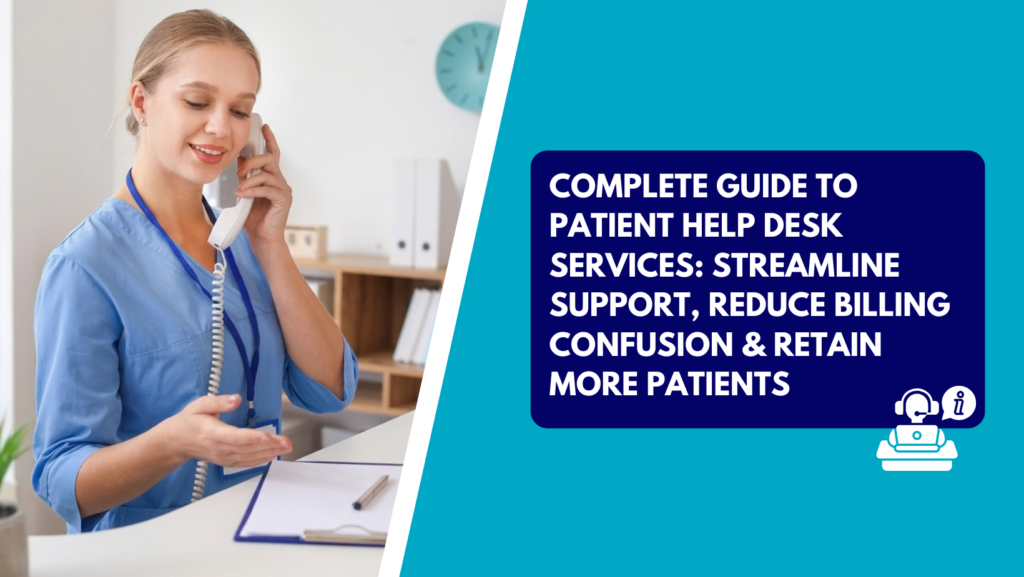
Complete Guide to Patient Help Desk Services: Streamline Support, Reduce Billing Confusion & Retain More Patients
Picture this. A patient opens their mail, pulls out a medical bill, and stares at it for a solid two minutes. The numbers do not match what the insurance company sent. Nobody at the clinic is picking up the phone. So they set the bill on the kitchen counter and walk away. Weeks pass. That balance sits unpaid. And your practice has no idea why.
This is not a rare situation. It happens at practices across the country, every single day. The good news? It is entirely preventable. What separates the practices that collect well and keep patients coming back from those that do not often comes down to one thing: a properly staffed, well run patient help desk.
Think of patient help desk services as the communication layer that sits between your billing department and your patients. It is where questions get answered, confusion gets cleared up, and payments actually get made.
In practical terms, a patient help desk handles the work that no one else in your practice has time to do properly. That includes explaining what an insurance payout actually covers, why a patient owes a specific amount, what a denial code means in plain terms, and how someone can set up a payment arrangement when they cannot cover the balance in one shot.
From an RCM perspective, this function is not optional. It sits at the point where patient satisfaction and revenue collection intersect. Get it right and both improve. Leave it unattended and both suffer.
- Real time responses to billing questions through phone, email, or patient portal
- Insurance eligibility checks before and after visits
- Clear explanations of claim status and denial reasons
- Payment plan coordination and financial counseling
- Fully HIPAA compliant communication across every channel
Key Insight A patient help desk is not a customer service expense. It is a revenue function. Every question that gets answered quickly is one less unpaid balance sitting in your accounts receivable.
When there is no dedicated support function, everyone suffers. Front desk staff field billing questions they were never trained to answer. Calls go to voicemail and stay there. Patients who feel ignored stop trying to resolve their balance and stop coming back altogether.
- Staff spend hours on billing calls that should be handled by a specialist, pulling them away from clinical work
- Unreturned voicemails pile up, each one representing a potential payment that never arrives
- Confused patients dispute or simply ignore bills, pushing AR days higher every month
- Denied claims sit unresolved because there is no one coordinating follow up on the patient side
- Negative online reviews mention billing problems and poor communication, scaring off new patients
- Revenue leakage builds quietly through unpaid balances and eventual write offs
Insurance Verification and Benefits Explanation
Before a patient ever walks through your door, a help desk confirms their coverage status. After the visit, it explains what insurance covered, what the patient is responsible for, and why. That one step alone eliminates the majority of billing disputes most practices deal with.
Statement Walkthrough and Billing Explanation
Itemized medical bills are genuinely confusing to most people. CPT codes, modifiers, and coordination of benefits language are not things patients learn in school. A good help desk takes those statements apart and explains them in terms a patient can understand and act on.
Payment Support and Financial Counseling
Not every patient can pay in full. A help desk bridges that gap by setting up structured payment plans, identifying assistance programs the patient may qualify for, and keeping the collection moving forward without damaging the relationship in the process.
Denial Follow Up and Claim Coordination
Most patients never know their claim was denied until they get a bill for the full amount. By then they are already frustrated and the window for easy resolution has closed. A proactive help desk catches denials early, reaches the patient before the panic sets in, and coordinates with the billing team to fix the issue at the source.
HIPAA Compliant Communication
Every patient interaction carries regulatory weight. All communication, whether through phone, email, or secure portal, must meet HIPAA standards. A professional help desk has that infrastructure already in place so your practice never has to worry about compliance gaps.
| Factor | In House Help Desk | Outsourced Help Desk (CareRCM) |
|---|---|---|
| Cost | High. Salaries, benefits, ongoing training | Predictable, cost effective model |
| Availability | Office hours only | Extended coverage beyond office hours |
| Billing Expertise | Inconsistent, needs constant training | RCM trained specialists from day one |
| Scalability | Slow and expensive to scale | Scales instantly with patient volume |
| HIPAA Compliance | Requires internal setup and monitoring | Built in compliance framework |
| Technology | Additional tools cost extra | Integrates with your existing EHR and PM |
| Turnover Risk | Staff changes cause real disruptions | No disruption. Continuity is guaranteed |
| Patient Satisfaction | Varies widely by staff member | Consistently high and measurable |
Pro Tip Most practices that switch to outsourced patient billing assistance cut their per contact costs by 30 to 50 percent within the first quarter. And that is before accounting for the gains in first call resolution and faster collections.
Scenario One: The Bill That Made No Sense
A patient sees an in network specialist and walks away expecting a routine copay. Weeks later a bill for $480 lands in their mailbox. Their insurance sent an explanation of benefits that looks nothing like the bill. They call the clinic. Nobody picks up. They leave a message. Nobody calls back. The balance ages past 90 days and eventually gets written off.
With a patient help desk in place, that same situation ends very differently. A specialist calls the patient within 24 hours, walks through both documents side by side, confirms the in network processing was applied correctly, and sets up a three month payment arrangement on the spot. Balance collected. Patient kept. Problem solved.
Scenario Two: The Denial Nobody Mentioned
A claim gets denied for a missing prior authorization. The insurer notifies the provider. The provider files it away. Nobody tells the patient, who then receives a bill for the full amount and immediately assumes something was billed wrong. By the time they call in, they are already upset. The window to fix it through appeal has nearly closed.
A proactive help desk catches that denial the day it comes in. The patient gets a call that explains exactly what happened, what the next step is, and what they should expect. The appeal gets filed with the correct information attached. The claim gets paid. The patient feels taken care of instead of ignored.
Key Insight Patients who receive a clear, timely explanation of their billing are 2.5 times more likely to pay their full balance on time. Communication is the most underrated collection tool in healthcare.
The numbers here are not subtle. Practices that invest in structured patient help desk services consistently see measurable improvements across their revenue cycle metrics.
- Patient responsibility collection rates climb by 15 to 25 percent on average
- AR days fall as patients pay faster once they actually understand what they owe
- Denied claims get resolved at higher rates when the patient side of the follow up is managed properly
- Patient retention improves because billing satisfaction plays a much bigger role in loyalty than most practices realize
- Clinical and admin staff are freed up to focus on work that actually requires their specific expertise
- Patient Reaches Out. A patient contacts the help desk through their preferred channel, usually phone but increasingly through email or a patient portal, with a billing question or a concern about their statement.
- Secure Identity Verification. Before any account details are accessed, the specialist verifies the patient’s identity through established HIPAA compliant protocols. No shortcuts here.
- Full Account Review. The specialist pulls up the account and reviews the relevant claims, payments, and insurance activity to understand exactly what the patient is looking at and why they are confused.
- Plain Language Explanation. The patient gets a clear, jargon free walkthrough of their bill, what insurance covered, what the patient portion is, and why the numbers are what they are.
- Resolution or Coordinated Escalation. Straightforward issues get resolved on the spot. Anything involving a denied claim or billing dispute gets escalated to the billing team with full context already documented.
- Payment Is Collected or Arranged. If the patient is ready to pay, the specialist handles it right then. If they need time, a payment plan gets set up on the call without additional friction.
- Follow Up Until Closed. Open cases stay on the radar. The help desk follows up proactively and does not mark an issue resolved until the patient confirms satisfaction or the balance is paid.
Pro Tip The best patient help desks are built around a first call resolution goal. That means training specialists to solve the problem fully in one interaction, not hand it off and hope someone calls back. That approach alone cuts callback volume in half at most practices.
- AR Days Are Climbing. Balances aging past 90 days usually mean patients are confused, not unwilling to pay. Confusion is fixable.
- Billing Calls Are Overwhelming Staff. If your front desk is drowning in billing questions, that is a structural problem, not a staffing one.
- Patients Are Regularly Disputing Bills. Frequent disputes are a sign of a clarity problem, not a pricing problem. Better communication fixes this faster than better billing software.
- Collection Rate Under 70%. If less than 70 cents of every dollar owed by patients is being collected, there is a gap that structured support can close.
- Reviews Mention Billing Problems. Online reviews that mention billing confusion or poor communication are costing you new patients right now.
- Staff Feel Pulled in Too Many Directions. Billing support work assigned to clinical or administrative staff almost always gets done last, and patients feel that.
Improve Patient Experience with a Dedicated Help Desk
Get expert patient support solutions designed to reduce billing confusion, improve satisfaction, and boost collections for your practice.
CareRCM was built specifically for the billing and revenue cycle challenges that U.S. healthcare providers face. Our professional patient help desk services are not a call center product with a healthcare label slapped on it. Every specialist we put on a patient call understands RCM workflows, insurance processing, denial logic, and what actually drives collection.
| What CareRCM Brings | Why It Matters to Your Practice |
|---|---|
| RCM Trained Specialists | Agents who understand billing, not just how to stay on script |
| HIPAA Compliant Infrastructure | Every channel, every interaction, zero compliance exposure |
| EHR and PM System Integration | Works inside the tools your team already uses |
| First Call Resolution Focus | Faster closures, fewer callbacks, patients who actually feel helped |
| Transparent Monthly Reporting | Clear data on call volume, resolution rates, and collection impact |
| Fully Scalable Support | Grows as your practice grows, without adding to your payroll |
Frequently Asked Questions
-
Your billing team is focused on claim submission, payment posting, and insurance follow up. That work requires their full attention. What patient help desk specialists handle is the patient facing side: explaining statements in plain terms, fielding questions that come in after hours, setting up payment arrangements, and managing the communication around denied claims before patients become upset. The two functions are different, and trying to merge them puts both at risk. When your billers spend time on patient calls, claim work slows down. When patient calls are not answered, collections slow down. A dedicated help desk removes that conflict entirely.
-
A reputable outsourced patient support provider operates under a Business Associate Agreement with your practice, which is a HIPAA requirement for any vendor that accesses protected health information. Beyond the legal framework, compliance is maintained through encrypted communication channels, role based access controls, staff training, and documented data handling procedures. CareRCM's infrastructure is built with these requirements at the foundation, not retrofitted as an afterthought. Every patient interaction is logged, every channel is secured, and your practice carries no additional compliance burden from outsourcing this function.
-
Most practices are fully onboarded within two to three weeks. The process involves integrating with your existing EHR or practice management system, establishing call handling protocols that match your workflows, training specialists on your specific payer mix and patient population, and setting up reporting dashboards so you have visibility from day one. There is no lengthy implementation cycle, no infrastructure investment on your end, and no learning curve for your internal staff. From the patient's perspective, the transition is seamless. From your perspective, you start seeing measurable improvement in collection rates and patient satisfaction within the first billing cycle.
Ready to Transform Your Patient Support Experience?
Stop letting billing confusion cost you collections and patient trust. CareRCM's dedicated patient help desk gives your practice 24/7 coverage, HIPAA compliant communication, and specialists trained to turn frustrated patients into satisfied ones.
Get Started TodayDisclaimer: Patient satisfaction benchmarks, collection rate improvements, and help desk performance figures referenced in this guide reflect publicly available information, industry research, and CareRCM professional RCM experience as of April 2026. Individual practice outcomes vary based on patient volume, payer mix, existing communication infrastructure, and billing complexity. All HIPAA compliance, data handling, and patient communication guidance reflects current HHS and CMS standards. Patient help desk references are intended as general guidance only; specific workflows, staffing requirements, and compliance obligations should be verified with a qualified RCM specialist for your practice.