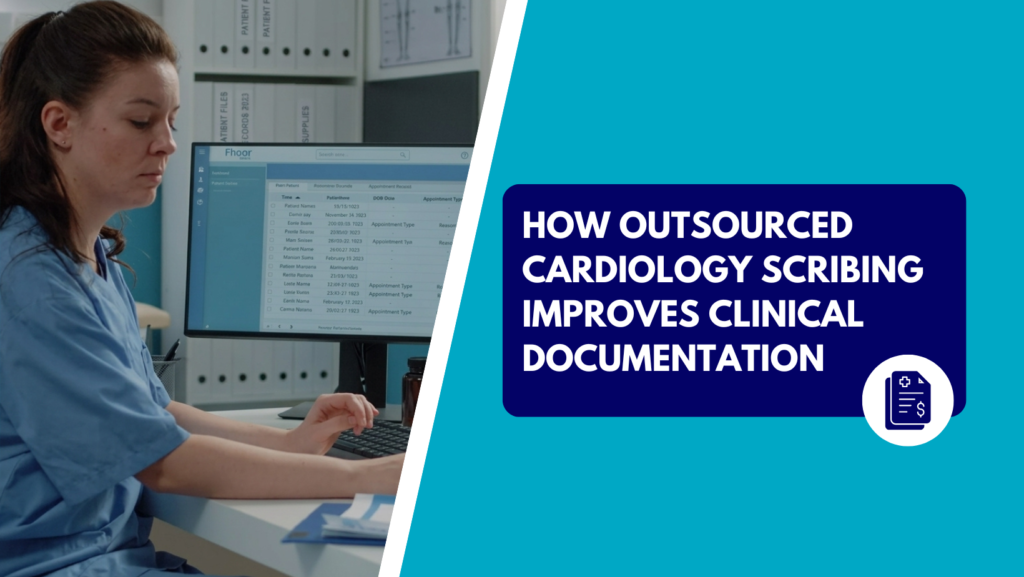
How Outsourced Cardiology Scribing Improves Clinical Documentation
A cardiology note has several jobs. It records what happened in the room, helps the next clinician pick up the thread, and gives coders and billers the evidence they need to report the visit correctly. When a note is late, thin, or inconsistent, the cost rarely shows up on the day of the visit. It shows up weeks later as coder queries, held claims, and rework.
Outsourced cardiology scribing is one way practices try to protect documentation quality without asking physicians to type through their evenings. At Care RCM, we are a medical billing and revenue cycle company, not a scribing vendor. We see what documentation does to claims, so this guide looks at scribing through that lens: what it does, where it helps, what it cannot fix, and how to evaluate it.
Quick answer
Outsourced scribing can make cardiology documentation more complete, timely, and consistent, which supports cleaner coding and billing. It does not replace the clinician, who must review and approve every note. It also does not guarantee higher reimbursement.
Few specialties pack as much into one encounter. A single follow up visit may include a symptom review, an ECG or echocardiogram result, a stress test or monitor report, a medication discussion, and a plan that points toward imaging, a procedure, or a referral. Each piece has to land in the record in a way another reader can follow.
The pressure points we see most often are operational, not clinical:
- Notes finished after clinic hours, when details have faded
- Diagnostic results mentioned but not clearly reviewed or tied to the plan
- Copied forward text that no longer matches the current visit
- Procedure notes missing details a coder will need
- Medication changes discussed but recorded in vague terms
This matters because of how visits are leveled. For office and outpatient evaluation and management services, the level can be selected using medical decision making or total time on the date of the encounter, following AMA CPT guidelines that CMS adopted. Either route depends on a note that shows the work. Confirm current CPT guidance and payer policy before changing any process.
A medical scribe is a documentation assistant. Working live or from recorded encounters, depending on the arrangement and patient consent, the scribe captures what the clinician says and does and drafts the note in the practice’s EHR or template. The scribe does not diagnose, decide, or add clinical judgment. “Outsourced” simply means the scribe works for an outside organization under a contract with agreed standards.
In cardiology, that support can include:
- Drafting the visit narrative as the clinician describes it
- Organizing references to ECG, echo, stress testing, and monitoring results
- Recording medication changes exactly as stated by the clinician
- Drafting procedure note sections for physician completion
- Capturing follow up instructions and care plan items as directed
Established fact versus recommendation
CMS addresses scribes in the Medicare Claims Processing Manual (Publication 100 04), Chapter 12, Section 30.6.1. In general terms, the practitioner who bills the service must authenticate scribe entries and confirm they reflect the work performed. Some Medicare contractors and payers add expectations, such as identifying the scribe in the record. Our recommendation is to verify the rules for each of your payers before you start.
A clear path keeps everyone honest about who does what. Here is a simple version.
Coders translate documentation. They do not invent it. If a note does not show that a test was reviewed, or why a procedure was needed, the coder has to send a query or report conservatively. Either path slows the claim.
Stronger documentation can support revenue cycle work in a few practical ways:
- Coding accuracy: clearer notes give coders less to interpret.
- Claim quality: orders, results, and the visit note tell a consistent story.
- Fewer queries: recurring gaps get caught at the source.
- Faster record requests: when a payer asks for records, a clear note shortens the response.
A necessary caution: scribing does not automatically raise reimbursement. Payment depends on payer policy, medical necessity, accurate coding, and clean claim submission. The realistic benefit is fewer avoidable errors and delays.
Our Cardiology Billing Services team works from the documentation your practice produces, so we pay close attention to where notes and claims drift apart.
Review documentation related billing bottlenecks
If you suspect incomplete or late notes are slowing your claims, we can look at the billing side with you. No pressure, just a clear view of where the friction sits.
Neither model is better in every practice. This table lays out the tradeoffs.
| Area | Typical in house workflow | With outsourced scribing support |
|---|---|---|
| Provider time | Clinician writes the note during or after the visit. | Clinician reviews and edits a drafted note. Time saved depends on draft quality. |
| Consistency | Varies by clinician, schedule, and fatigue. | Template driven drafts can add consistency if scribes are well trained. |
| Turnaround | Depends on clinic load. | Targets can be written into the service agreement. |
| Quality review | Often self review. | Can include scribe audits plus physician sign off. Ask the vendor how. |
| Coding readiness | Coders query missing details. | Fewer gaps are possible when drafts flag unclear items. |
| Admin burden | Staff chase unsigned notes. | Less chasing, but new vendor management and onboarding tasks. |
| Cost view | Cost sits in physician hours and delays. | Adds a vendor fee. Model both sides before deciding. |
The treating clinician remains responsible for the final record. A scribe drafts, the clinician decides, and the signature means the clinician has read the note and agrees with it. Outsourced scribing never replaces clinical judgment, and signing without reading defeats the purpose.
Good programs usually build in cardiology specific training, a practice style guide, regular chart audits, a feedback loop for errors, and a clear way to handle dictation that is hard to follow.
An outside scribe handles protected health information, so the vendor is generally a business associate under HIPAA. HHS expects a business associate agreement and appropriate safeguards under the Privacy and Security Rules, such as access controls, encryption, and audit logs. Practices should also ask about remote workstation rules, where data is stored, who can access it, how recordings are handled, and breach notification. Recording consent rules can differ by state. This is operational guidance, not legal advice, so involve your compliance lead or counsel.
- Physicians regularly finish notes after hours
- Unsigned or incomplete notes delay charge capture
- Coders keep querying the same documentation gaps
- Provider volume is growing and in house hiring is slow
- Someone on your team can manage vendor quality
It may fit less well when visit volume is low, EHR templates are unstable, or no one can oversee quality. In house scribes, better templates, and training are also fair options to weigh.
☐ Do your scribes have cardiology training, and how is it verified?
☐ How do you handle ECG, echo, stress test, monitoring, and catheterization terminology?
☐ Will you sign a business associate agreement, and how is PHI protected?
☐ How are recordings handled, and how is patient consent captured?
☐ How will the scribe be identified in the note?
☐ What turnaround should we expect for drafts?
☐ How do you measure accuracy and feed errors back?
☐ Which EHR systems have you worked in, and can we speak with a reference?
☐ What happens when dictation is unclear?
☐ What are the exit terms, and how is our data returned?
Discuss cardiology revenue cycle needs
Not sure how documentation gaps look from the billing side? Talk with the Care RCM team and bring a few sample workflows.
Talk with the Care RCM teamAnswer yes or no for your practice, then count your yes answers.
☐ Do physicians regularly complete notes after clinic hours?
☐ Are claims held because notes are unsigned or incomplete?
☐ Do coders query the same kinds of gaps again and again?
☐ Do diagnostic results appear without a clear review or plan?
☐ Do copied forward sections show up in follow up notes?
☐ Does answering a payer record request take long chart cleanup?
Yes answers | What it may suggest |
0 to 1 | Documentation may not be your main bottleneck. Keep monitoring. |
2 to 3 | Worth reviewing a small sample of recent charts. |
4 to 6 | Documentation may be affecting billing. A structured workflow review could help. |
This is a conversation starter, not a formal audit.
- Pull a sample of recent cardiology encounters and compare notes with submitted claims.
- Track how long notes stay unsigned.
- List the five most common coder queries.
- Decide what is really broken: templates, training, scribing support, or billing workflow.
- If you pilot a scribing vendor, agree on how you will judge results before you start.
Frequently Asked Questions
-
It is a documentation support service in which an outside team drafts cardiology notes from encounters under clinician direction. The clinician reviews and approves the final record.
-
No. The treating clinician remains responsible for the accuracy of the final note and must review and sign it.
-
It can support accuracy by making notes more complete and consistent, which helps coders. It does not guarantee higher payment or fewer denials.
-
That depends on the vendor and the arrangement. Expect a business associate agreement and documented safeguards, and confirm both before sharing any patient information.
-
Pricing varies by vendor, volume, and service model. Compare the fee against the cost of physician after hours time and delayed claims.
-
No. Care RCM provides medical billing and revenue cycle services, including medical coding, for cardiology and other specialties. We can help you assess how documentation affects your billing.
-
Look for repeated coder queries, unsigned note backlogs, and slow record request responses. The self assessment above is a good starting point.
Better documentation starts before the claim, and strong cardiology billing depends on it. If you are weighing scribing, templates, or a broader workflow change, we are glad to review the billing side with you. Care RCM is a US based, HIPAA compliant billing and revenue cycle company, and our team can help you spot where notes and claims fall out of step.
Protect Your Bottom Line From Complex Cardiac Denials
Don't let complex coding rules, prior authorization hurdles, and payer updates squeeze your practice profits. Get specialized cardiology revenue cycle options at a fraction of your monthly collections and experience the upgrade in days.
Schedule Your ConsultationDisclaimer: Denial rates, performance benchmarks, and revenue improvement figures referenced in this guide reflect publicly available information, industry research, and Care RCM professional RCM experience as of September 2026. Individual practice outcomes vary based on payer mix, specialty volume, existing billing infrastructure, and claim complexity. All CPT code, modifier, and compliance guidance reflects current CMS and AMA standards. Cardiology billing references are intended as general guidance only; specific coding and bundling rules should be verified with a qualified billing specialist for your practice.