
AI EHR vs Traditional EHR Systems: Key Differences in 2026
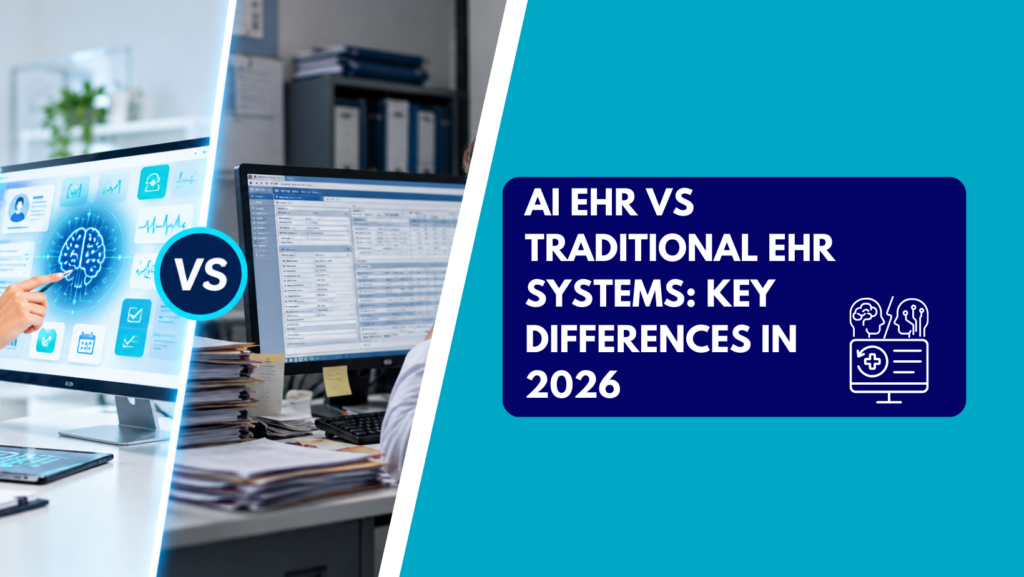
Cardiology leaders keep asking: do we replace our EHR, or add AI to the one we have? Fair question, but “AI EHR” isn’t a tidy product category. As a revenue cycle management company, we watch how charting choices travel into coding, claims and payment. So here’s AI EHR vs traditional EHR systems in plain terms, plus what cardiology practices should verify before buying.
A traditional EHR is the system of record for patient care. Core functions usually include patient records, encounter notes, orders, medications, results, documentation templates, clinical summaries and links to scheduling and billing workflows, plus data exchange where supported. Many already include rules based alerts, analytics and automation, so “traditional” doesn’t mean basic.
Usually it’s a core EHR plus AI capabilities, built in or connected through integrations. The core platform manages the record. The AI layer assists with specific tasks, such as:
- Ambient clinical documentation: note drafting from the visit conversation.
- Chart summarization and natural language search: faster review of long records.
- Automated administrative tasks: inbox sorting or form preparation.
- Predictive alerts and decision support: risk flags and suggestions.
- Coding support: suggested codes for human review.
Some features ship with the platform; others are paid add ons or vendor specific. Every AI output is a suggestion: a clinician must review it, and a qualified coder must confirm it against what was actually performed. Under ASTP/ONC’s HTI 1 rule, certified EHR developers must share source and risk management details for predictive tools they supply. Ask to see them.
| Area | Traditional EHR | AI Enabled EHR Environment | What a Cardiology Practice Should Verify |
|---|---|---|---|
| Documentation | Templates, typed or dictated | May draft notes from the visit | Note accuracy and edit time |
| Data entry | Manual, structured fields | Suggested or auto populated entries | Source of suggestions, fixes |
| Chart review | Manual search and scrolling | Summaries and natural language search | Links back to source entries |
| Clinical workflow | Configurable pathways | Adaptive prompts, automation | Fit with visits, testing, results |
| Decision support | Rules based alerts | Rules plus predictive models | Evidence, validation, alert volume |
| Interoperability | Standards based, where supported | Depends on integration quality | Two way data flow, test results |
| Customization | Templates, order sets | Prompts, models, settings | Who controls changes and updates |
| Human review | Clinician signs the note | Reviewing AI content is essential | Sign off before finalizing |
| Privacy and security | Access controls, logs | More data flows, vendor data use | Retention, model training, contracts |
| Implementation effort | Defined setup, migration | Pilot, tuning, integration | Timeline, staff time, support |
| Cost considerations | Licensing and support | Adds AI fees, integration, review | Full cost of ownership |
| User training | Navigation, templates | Adds review habits and AI limits | Role specific training plan |
| Auditability | Standard audit trails | Needs logs of AI drafts, edits | AI drafts versus clinician edits |
| Revenue cycle workflow | Charge capture, billing hand offsh | May add coding suggestions | Check against services performed |
Cardiology charts are dense. One patient can generate office visits, echocardiograms, stress tests, cardiac imaging, procedures, device related services, medication reconciliation, referrals, results review and years of longitudinal records.
- Visit notes: drafts must reflect the real history, exam and plan.
- Testing and imaging: results and interpretations must land in the right place.
- Device follow up and chronic care: records must stay linked over time.
We won’t name vendors or assume a product supports a cardiology feature. Ask for proof in a demo using your own workflows.
| Potential benefit | Matching limitation |
|---|---|
| Less repetitive documentation | Inaccurate or missing generated content |
| Faster chart review | Summaries that miss context or lean on outdated data |
| More structured information | Overdocumentation and bias from incomplete data |
| Reduced manual work | Extra review burden and workflow friction |
| Easier access to relevant information | Poor integration and user distrust |
| Better workflow visibility | Alert fatigue |
An EHR doesn’t guarantee correct coding or payment. What it can do is make good documentation easier to produce and find. Charge capture, code review, claim preparation, medical necessity support, prior authorization documentation, denial prevention, audit readiness and reporting all depend on what was recorded about a service that really happened. That’s why dependable Cardiology Billing Services start with documentation quality.
AI generated notes or code suggestions must be checked against the services performed and the coding and payer rules that apply. Nobody should add unsupported detail, upcode or change documentation just to raise reimbursement.
Stage 1 Patient encounter | Stage 2 EHR documentation | Stage 3 Clinician review | Stage 4 Coding and charge review | Stage 5 Claim submission | Stage 6 Denial and payment monitoring |
| Criterion | Your score |
|---|---|
| Cardiology workflow fit |
|
| Documentation usability |
|
| Accuracy review process |
|
| Interoperability |
|
| Security controls |
|
| Audit logging |
|
| User training |
|
| Implementation resources |
|
| Vendor support |
|
| Total cost |
|
| Billing workflow compatibility |
|
| Result | Total (of 22) | Next move |
|---|---|---|
| Strong Fit | 18 to 22 | Move to a limited pilot with clear success measures. |
| Needs Validation | 11 to 17 | Close the gaps with the vendor before committing. |
| Major Gaps | 0 to 10 | Fix workflows or reconsider the option. |
| # | Question | Yes or not yet |
|---|---|---|
| 1 | Do you measure charting burden, including after hours work? |
|
| 2 | Do clinicians want AI help and accept reviewing every draft? |
|
| 3 | Is your chart data reasonably complete and consistent? |
|
| 4 | Has IT confirmed it works with your EHR and devices? |
|
| 5 | Is a privacy and security review done or scheduled? |
|
| 6 | Does someone own AI governance and incident reporting? |
|
| 7 | Is a training plan ready for clinicians and staff? |
|
| 8 | Do billing and coding teams have a say in documentation changes? |
|
| Result | Points | Practical next action |
|---|---|---|
| Strong Fit | 7 to 8 | Pilot one workflow in one clinic and measure it. |
| Needs Validation | 4 to 6 | Close the gaps in data, governance or training first. |
| Major Gaps | 0 to 3 | Fix workflows and data quality before buying more technology. |
| Risk | Early warning sign | Potential impact | Mitigation |
|---|---|---|---|
| Inaccurate generated notes | Frequent clinician edits | Wrong record, claim risk | Review before signing, error tracking |
| Missing clinical context | Summaries skip prior testing | Weak care and support | Summaries linked to source entries |
| Poor interoperability | Manual re-entry of results | Delays and duplicate work | Test data exchange in the pilot |
| Data exposure | Unclear vendor data use | Privacy incident | Risk analysis, contracts, access limits |
| Automation bias | Notes signed with no edits | Errors become routine | Spot audits and training |
| Workflow disruption | Chart completion delays | Staff frustration | Small pilot, adjust before scaling |
| Integration errors | Missing or mismatched charges | Claim rework | Reconcile EHR and billing data |
| Unclear accountability | No owner for AI issues | Slow incident response | Named owner and escalation path |
- Keep your EHR and add targeted AI tools when the core system works, one pain point is clear (note drafting, chart search) and the tool integrates cleanly.
- Evaluate a wider AI enabled platform when your EHR limits interoperability or keeps causing workflow problems and you can fund migration and training.
- Fix workflows and data quality first when templates are inconsistent, data is incomplete or staff already struggle with adoption. Technology magnifies what’s already there.
AI is an assistive capability, not a substitute for clinician judgment or accountable human review; the AMA calls it augmented intelligence for that reason. If a tool touches protected health information, bring it into your HIPAA risk analysis, which HHS treats as the foundation of Security Rule compliance. Review access control, audit logs, encryption, retention, business associate arrangements where applicable, model training on your data, clinician review, monitoring and incident response. A “HIPAA compliant” label alone isn’t proof, so ask for evidence and confirm obligations with qualified counsel or compliance professionals.
- How are errors tracked, and how was the tool evaluated?
- What changes with updates, and how will we know?
- Can we see logs of AI drafts next to clinician edits?
- Is our data used to train models, and for how long is it kept
- What is your escalation procedure for incidents?
| Stage | What to verify |
|---|---|
| Problems are measured | |
| Hand offsh from visit to charge | |
| Each feature solves a named problem | |
| Risk analysis, contract and data terms | |
| Flow with labs, imaging, devices, billing | |
| Representative visits and providers | |
| Review habits and escalation steps | |
| Compare with pre launch numbers | |
| Errors, user concerns, operations | |
| Results and safeguards support scale |
Look past the license. Evaluate licensing, AI fees, integration, data migration, implementation, training, workflow redesign, support, security review and the staff time spent checking AI output. We won’t quote market prices, and no vendor can honestly promise a guaranteed return.
What should a practice calculate before purchasing AI EHR features? Add one time and recurring costs over a fixed period, include internal review time, then compare the total with measured changes from your own baseline, such as documentation time or claim rework. If you can’t measure it, you can’t value it. |
| Metric | What it tells you |
|---|---|
| Documentation completion time | Is charting faster |
| Note correction rate | How often AI drafts need fixes |
| Clinician adoption | Real usage |
| User satisfaction | Trust and usability |
| Chart completion delays | Backlog and strain |
| Workflow exceptions | Where the process breaks |
| Help desk tickets | Support load |
| Claim rework related to documentation | Billing friction |
| Coding query volume | Documentation clarity |
| Denial patterns plausibly tied to documentation | Possible links to review |
| Total implementation cost | Spend versus results |
Once you’ve chosen between an AI enabled EHR, a traditional EHR or AI tools added to your current system, ask a harder question: can complete, accurate documentation move into compliant coding and claims without friction? Care RCM is a healthcare revenue cycle management company; we don’t sell or implement EHR software. Our team supports cardiology practices with coding and billing workflows, prior authorization, eligibility verification, claim and denial management, accounts receivable follow up and payment posting, alongside the EHR and practice management systems you already use. Coding follows what was documented and performed, nothing more.
Next steps for your cardiology practice Review our Cardiology Billing Services page to see how we support cardiology medical billing. Assess Your Cardiology Revenue Cycle or Discuss Your Billing Workflow with our team. Contact Care RCM any time. |
Frequently Asked Questions
-
An electronic health record with AI features such as note drafting, chart summaries or predictive alerts. It is often a core EHR with AI added, and features vary by vendor and version.
-
A traditional EHR organizes, stores and exchanges clinical information. An AI enabled environment adds assistive tools for documentation, search, prediction or automation. Both may automate, so compare features.
-
Often yes, through integrations or add ons, but quality varies. Test data flow in both directions.
-
Workflow fit, note accuracy, interoperability, security, audit logs, training, cost and billing compatibility. Pilot with real cases.
-
Yes. They can include inaccuracies or omissions, so clinicians must review and edit before signing.
-
Include it in your HIPAA risk analysis and review access, audit logs, encryption, retention, vendor data use and business associate terms. A compliance claim alone isn't enough.
-
It can support them with clearer documentation and smoother hand offs, but it doesn't guarantee correct coding or payment.
-
No. Denials stem from eligibility, authorization, coding, payer rules and more. Compare against your own baseline.
-
Count licensing, AI fees, integration, training, support, security review and staff review time, then compare with measured changes.
Protect Your Bottom Line From Complex Cardiac Denials
Don't let complex coding rules, prior authorization hurdles, and payer updates squeeze your practice profits. Get specialized cardiology revenue cycle options at a fraction of your monthly collections and experience the upgrade in days.
Schedule Your ConsultationDisclaimer: Denial rates, performance benchmarks, and revenue improvement figures referenced in this guide reflect publicly available information, industry research, and Care RCM professional RCM experience as of September 2026. Individual practice outcomes vary based on payer mix, specialty volume, existing billing infrastructure, and claim complexity. All CPT code, modifier, and compliance guidance reflects current CMS and AMA standards. Cardiology billing references are intended as general guidance only; specific coding and bundling rules should be verified with a qualified billing specialist for your practice.